
The Body Knows
On dust, memory, and what "green" doesn't always mean

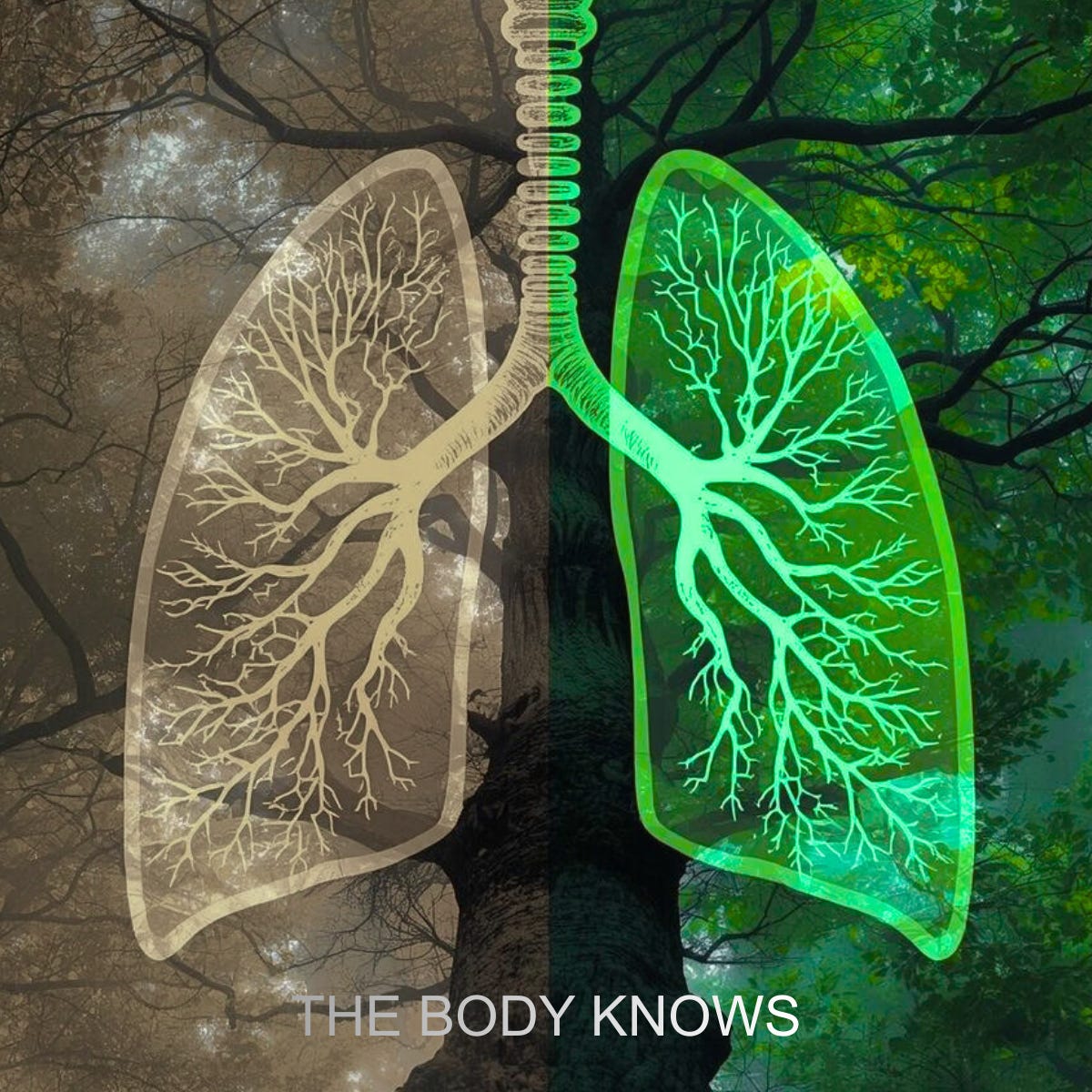
I read Jake Skeets this morning over tea, his essay Summer Light arriving in my inbox from Emergence Magazine on a March Sunday in the Poconos. He writes from the Navajo Nation about aridification, about wildfire smoke slanting the light pink, about seasons living in the body the way memory lives in time. He writes: seasons are to the body what memory is to time. I read that sentence and felt it land somewhere specific — not the mind, but the chest.
I had just returned from India.
In February, I traveled to Govardhan Eco Village (GEV) in Palghar, Maharashtra, a retreat community nestled in green hills an hour and a half north of Mumbai. I had gone seeking what retreats promise: stillness, renewal, a recalibration of the interior. I found all of that, and more; I found a quality of spiritual nourishment that I am still, weeks later, absorbing in layers.
The spiritual experience was unforgettable. But my body, specifically my lungs, also found something they had not been prompted to remember. The trees at GEV were the color of loden. Living in places like Maryland, New Jersey, Pennsylvania suburbs, I had forgotten the look of dust-laden greenery. They were the color of dusty, grey-green wool coats that suppressed light. Every leaf in the village wore a film of accumulated earth, five months of dry season settling like a second skin over living tissue. The trees were breathing, technically. But they were not clean.
Within days, the familiar tightening of the chest began. A bronchospasm. Congestion that mimicked a cold but wasn’t one. A chest that remembered something it had spent thirty-eight years trying to forget.
I grew up in Delhi in the 1970s and 80s, and I had severe asthma during those years. Not the inconvenient kind, it required weekly allergy injections, involved near-death experiences, with the particular terror of a body that would not take in air. I learned early that breath is not guaranteed. In later years, in spiritual readings, I have come across the statement that we are not breathing, as much as we are being breathed. It was always true for me that the atmosphere is not neutral, that the world outside your skin can decide, without consulting you, to become hostile.
When I moved to the United States in 1988, something extraordinary happened. My asthma vanished. The condition didn’t improve; it vanished. As if it had never existed. Maryland’s humid, forested, EPA-regulated air simply withdrew the invitation my immune system had been perpetually RSVPing to. My immune system stood at ease for the first time in years. Over the decades, first Maryland, then New Jersey, and finally the Poconos, where I now live, my respiratory system experienced what one might call an upward spiral of clean air. The Poconos, with its forest density and minimal industrial footprint, typically registers an AQI between 10 and 25. My lungs have, over time, lost their callouses.
This is what made the Palghar air such a precise and disorienting shock to my system.
At GEV, I learned how they construct their buildings from Compressed Stabilized Earth Blocks (CSEB), with mud bricks made on-site, a commendable expression of low-impact, land-honoring architecture. In February, the driest month in Maharashtra, the production and handling of these earth-based materials generate significant quantities of silica and soil dust. Add to this the village’s ongoing expansion — new ponds, new student facilities, large-scale earthmoving — and the result is a localized dust bowl that will not clear until the June monsoon arrives to wash it all away.
By February, the trees at GEV have been acting as static air filters for five months. They have reached maximum capacity. What I was breathing, living inside the construction zone of a growing retreat, was likely pushing 200+ AQI in localized areas. I had traveled from an AQI of 15 to what the data suggests was an AQI of 200 in a matter of hours.
But the more startling discovery was this: the dust I was breathing at GEV was not modern dust. It was PM10, a coarse, crusty, physical grittiness. And that is precisely the composition of 1980s Delhi air, before the city’s pollution shifted toward the finer, more insidious PM2.5 of vehicular exhaust and industrial chemistry. My body wasn’t just reacting to Palghar; it was reacting to a chemical signature it had last encountered forty years ago, in a city where it had nearly died.
The body knew first. Before I had processed any of this intellectually, my lungs had already made the identification.
Here is the tension I keep returning to, the one that feels most honest to name: I became sick inside a place that also enriched my soul.
Govardhan Eco Village is one of the most deliberately and painstakingly designed ecological communities in India, and one of the few anywhere in the world where sustainability is not a marketing posture but a structural commitment embedded in every layer of the place’s conception and construction.
Established in 2003, GEV spreads across more than 100 acres in Palghar, guided by the principle of “simple living and high thinking.” Before a single building went up, a full hydrogeological study guided the land-use planning, dividing the site into recharge and discharge zones to preserve natural water flow and agricultural areas. Based on that survey, a ten-million-liter water pond was established to recharge groundwater aquifers and provide irrigation for five to six months of the year. GEV implemented a careful protocol for using different aquifers judiciously — shallow, unconfined basalt aquifers for domestic needs and deeper, confined aquifers for regulated agricultural use. The goal, from the outset, was independence from state water and power infrastructure, because rural India suffers from both the quality and quantity of electricity, making self-sufficiency not an aspiration but a necessity.
GEV houses a 100-kilowatt solar power plant and is expanding toward 150 kilowatts more, aiming to meet the community’s entire energy needs through solar alone. A 30-cubic-meter biogas plant processes food waste and cow dung to produce cooking fuel. A Soil Biotechnology water treatment plant processes 200,000 litres per day, filtering wastewater through layered soil and plant systems before returning it to use. A ten-million-liter rainwater harvesting pond collects monsoon runoff from the surrounding Sahyadri mountains. The buildings carry a platinum-green rating and are constructed from 400,000 locally made compressed stabilized earth blocks with an 80- to 90-year lifespan — nearly twice that of conventional brick. GEV has received the United Nations World Tourism Organization award for sustainable tourism, and its outreach extends to more than fifty tribal villages in the surrounding region.
This is a community that consulted hydroecologists before breaking ground. That mapped its aquifers before designing its kitchens. That asked, at every step, what the land could genuinely support and built accordingly.
What GEV is also doing, right now, is growing. New ponds, new student facilities, new infrastructure, the expansion of a vision that has already proven itself on a smaller scale. And in the dry February of Maharashtra, that expansion means earthmoving, exposed soil, and construction dust that has nowhere to go until the June rains arrive to wash everything clean.
The difficulty here is genuine, and it deserves to be named plainly. Clean air is a shared resource used by everyone but protected by no one — what Garrett Hardin would recognize as a tragedy of the commons. India’s regulatory framework for construction dust mitigation, while it exists on paper, is largely applicable only to cities that have already failed to meet national air quality standards — which means rural and peri-urban sites like Palghar exist in a kind of regulatory gap, carrying the burden of dust without the enforcement infrastructure that urban developers at least nominally face. Studies show that pollutant-intensive construction activities — excavation, earthfilling, material transportation, and vehicle movement on unpaved roads — cause a considerable rise in PM10 concentrations in and around a site. For a community whose very construction philosophy involves working with raw earth and mud bricks, the challenge is structural, not incidental. The dust is not a byproduct of carelessness. It is, in a sense, the shadow of the method.
And yet, this is precisely where GEV’s demonstrated commitment to science-based, deliberate stewardship positions it to lead. Evidence shows that incorporating dust mitigation measures into project schedules from the very beginning — rather than reactively — can considerably reduce PM concentration levels on and around construction sites. For an earth-building community with GEV’s technical sophistication, several interventions are both feasible and philosophically consistent with its existing values: scheduling major earthmoving and CSEB brick production outside the driest months of January through March; deploying water suppression systems or mist sprayers on active excavation zones; installing windbreaks or green barriers of fast-growing vegetation around brick-making areas to interrupt the dust’s travel path; using mulch and vegetative cover on inactive soil to prevent wind erosion — an approach that can reduce wind-borne particulates by up to 80 percent when properly maintained; and placing low-cost air quality sensors at the community’s perimeter to monitor localized PM10 levels in real time, giving site managers the data to pause high-dust activities when readings spike.
None of these requires abandoning earth construction. They require layering air quality consciousness onto an ecological ethic that already runs deep. GEV has already done this with water — mapping aquifers, designing recharge zones, and distinguishing between shallow and deep systems. There is every reason to believe it can bring the same rigor to the air. This is not a critique of where GEV is; it is a recognition of where it is going and an invitation, offered with genuine and heartfelt respect, to let the next chapter of its stewardship be as carefully considered as the first.
Skeets writes about sand twisters on the Navajo Nation — spirits, the elders said, that would take something from you if you walked into them. The children, of course, ran straight in. What Skeets understands now that the children couldn’t is that the elders were encoding environmental knowledge in the only language that survives generations: story. The dust was a warning. The twisters were data.
My body gave me the same data in Palghar, in the same wordless language. The bronchospasm was not due to anxiety. The congestion was not a cold. It was information, precise, accurate, historically grounded, about the air I was standing in. The body as instrument. The body is the most honest air quality sensor in the room.
On the Navajo Nation, aridification is advancing. Sand dunes are swallowing roads and homes. The trees, like GEV’s trees in February, are holding dust they have no rain to release. Skeets calls this a new kind of calendar — the excessive heat warning as a way of marking the summer, the singed pink light as a season unto itself. Climate change is rewriting the body’s relationship to weather, to land, to the air that constitutes us moment by moment.
I think about this from the Poconos, where the AQI is 15, and the trees are fully, lavishly, unencumbered green. I think about how many people do not have the option to relocate to cleaner air when their immune systems ask them to. I think about the children in 1980s Delhi, in current Palghar, in the communities surrounding construction sites across India, who are breathing that gritty PM10 not for one retreating week but for the whole of their formative years.
My asthma vanished because I could leave. That is the public health truth underneath the personal miracle.
Skeets ends his essay looking out at a landscape altered by heat and smoke, asking what the climate crisis will do to our interior relationship with seasons. I end mine having returned from a green retreat with lungs full of the past, grateful for the Poconos, unsettled by what I now understand.
The body knows. It always does. The question is whether we’ve learned to listen and whether we’re building the kinds of systems, spaces, and policies that deserve that trust.
Pragya Thakur is a National Board-Certified Health & Wellness Coach, MPH candidate at Boston University, and Director of Editorial and Quality Assurance at AccessSync. Her writing has appeared in the Philadelphia Inquirer and The Law Journal Newsletter. She publishes From Soil to Soul on Substack and The Stewardship Brief on LinkedIn.